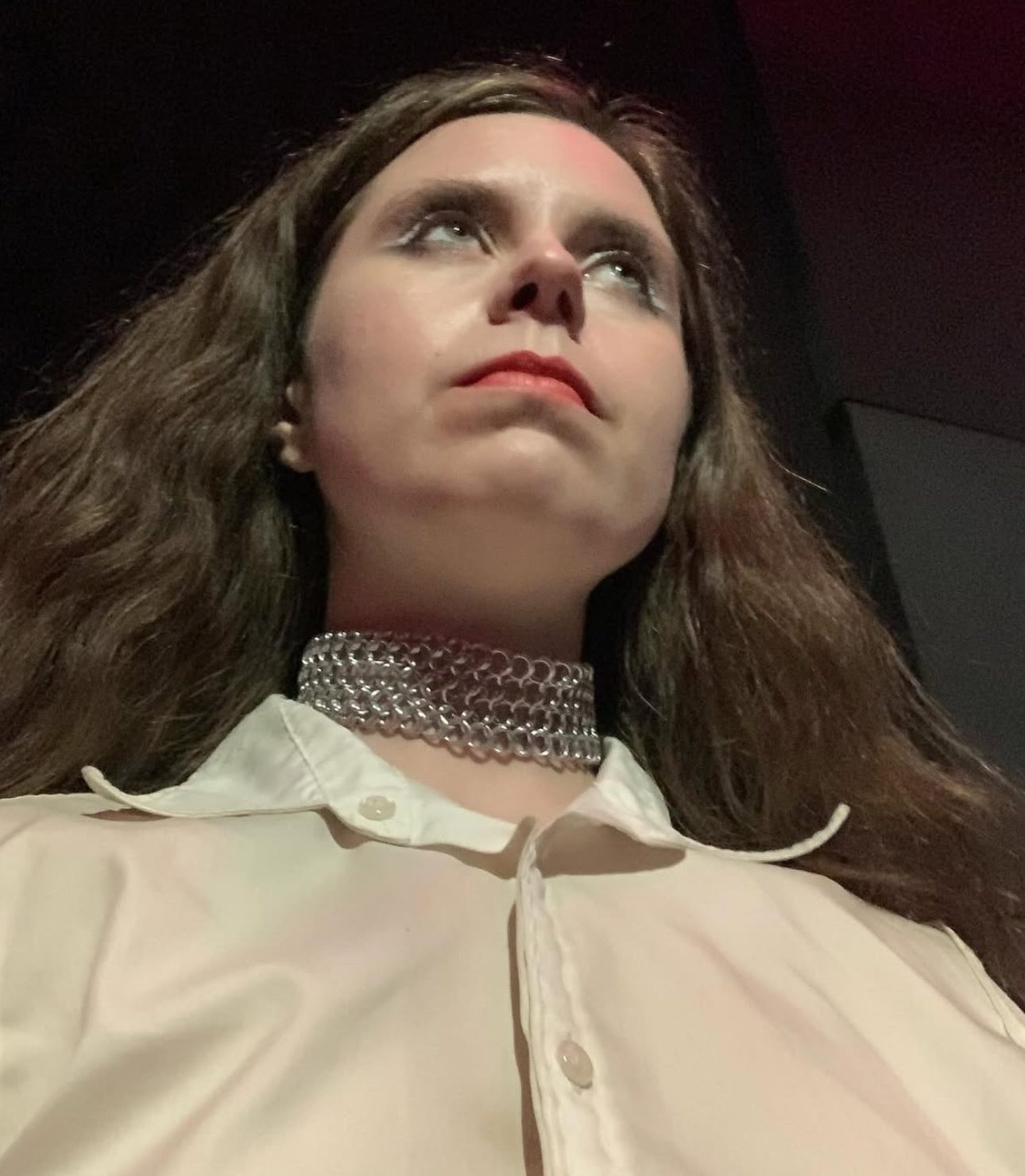
Words by Jason Lee
As most NYC’ers and yes the ‘C’ stands for crystallized droplets of frozen precipitation spent the past day barricaded behind closed doors thanks to a full 18 inches of the white, fluffy stuff blanketing the city’s motorways and walkways, it provided ample time to ponder the timely new single by avant-garde violinist, vocalist, and composer Lily Desmond, released this past Friday, a song born out of similar conditions of inclement-weather-induced confinement (a hurricane rather than a blizzard, but still!) with the song in question, “Regular Cassanova,” stripping away the more overtly folky and shoegazy, techno and indie-pop inflected influences of LD’s previous chamber-pop releases in favor of more straight-up chamber music, 99% raw and unpasteurized tho’ with traces of art rock and theatrical scoring…
…music whose roots lie in 18th-century Italian musica da camera—made to be performed in small, intimate spaces behind the fabled green door tucked away in aristocratic homes and palaces centuries ago or grotty basement grottos like those found today beneath NYC’s hipper dive bars for those in the know like at Bar Freda, where Lily and her chamber ensemble debuted “Regular Cassanova” this past Valentine’s Day night (!) with each individual musician in a given chamber ensemble playing a unique, standalone line with each individual part crucial to the greater whole (in contrast to the massed instrumental sections of a full-on orchestra)…


…thus making chamber groups something like the rock bands of their day playing house shows for the powdered wig set, with Lily’s self-assembled ensemble on “Regular Cassanova” consisting of violin, viola, cello, flute, trumpet, trombone, bass, drums, and “subtle synth textures” so why not huddle up next to yr apartment’s radiator or space heater whilst still confined indoors thanks to Snowpocolypse ’26 and give it a listen as you contemplate confinement, and as yr doing so, here’s Lily on the song’s origins:
“I was trapped in my dorm building in my freshman year of college during Hurricane Sandy on the East Coast. Someone had written most of Allen Ginsburg’s Howl along the walls of the 6 story stairwell out of boredom. Inspiration struck and I went to sit at the top of the steps by the entrance to the roof to get some space from my roommates. I started writing about a guy I knew who I had a crush on, and the reason I had a crush on him was because I wanted to fix him. I recognized that nurturing tendency in myself while also feeling uncomfortable about the fact that people often fall for the kind of person who would hurt them. There’s a dark magnetism that shows itself in some dangerous characters, a double-edged charisma that looks nice on a swashbuckler or a noir detective in a movie but can be destructive in a real person, regardless of their sex”…
…and indeed the lyrics and their delivery share an impressionistic unfurling quality not unlike Howl its lines strung together like they’re being read off the wall of a college dorm stairwell which after an austere string intro declares: “you’re a Regular Cassanova, shoulders and back of braille from bullet wounds, from ‘too soons,’ a life led on the rail, smile says, ‘come on over’, hands hold blood from the nights in the city in the dark where sleep brings only fright and the razor’s a glass and the edge is a spotlight on a bottle of something that stings” which is the first verse set against pinprick pizzacato strings as the arrangement builds steadily with swooping pizzicato strings, woodwinds and brass, rumbling bass frequencies and thudding drums entering the picture, elaborating on but centered on the main gavotte-like melodic figure (the gavotte is a slow and stately mid-tempo French dance whose dancers come off like vain, showy peacocks strutting and posing, showing off their feathers as they check themselves out in the mirror or maybe that’s just us…
…which by the time it reaches the bridge with the trombone taking over the main melody, supported by shuddering strings and airy flutes, it brings to mind nothing so much as the folk-horror soundtrack of The Wicker Man (1973) in all its paganistic glory and we all know how that one ended and while it’s low-key ‘lectrifying the way the song builds, crests and ebbs, and builds again, it also sounds (esp. if paranoiacally inclined) like the walls slowly closing in (cannot turn to face the skulls […] who’s life is really the one that’s full of lies?) burnt down to cinders at the very end (!) which again brings us to the theme of confinement, namely, the confinement of gender (big boy can I hold your hand? would I ever understand?) in all its hegemonic power wut with “the dark magnetism…the seductive pull of the ‘bad boy’ archetype” for both designated enactors and willing enablers, “and the [potential] damage from mistaking danger for romance” in the composer’s own words and here’s another quote:
I wanted this song to touch on the antagonist in all of us. The one that looks too much like your favorite dark hero from your favorite stories—or the one who got away. It wound up being an exploration of how romanticizing the power of that social archetype can bring out more toxic traits in everyone. That’s why I put an extra ‘s’ in Cassanova. In this song, he’s not a good guy. I thought a lot about the system wielding this gender role in the patriarchy as well, particularly the historical evolution of the desirable masculine in western culture, starting at Giacomo Casanova himself (I was definitely unconsciously pulling from Fellini’s Casanova as well as the one starring Heath Ledger from 2005). I wanted to express my interactions with this archetype of the reckless, dark masculine/bad boy and how it manifests in reality, versus how it is projected onto men by their partners, their institutions, and themselves. I’m currently working on a music video with director Niccolò Walsh that also delves into this, hopefully in a way that’s more light hearted and fun instead of a heavy indictment of a whole gender.
…which brings us back to the realm of 18th-century Italy and could it really be mere coincidence that arguably the first world-famous proto-rock-star style bad boy musician, widely known in his day as the Devil’s Violinist and whose near superhuman skill and flamboyance on the instrument led the public to suspect he must’ve made a Faustian pact was also borne out of this same Petri dish, namely, one Niccolò Paganini born in Genoa, Italy in 1782 (16 years before Casanova’s death) who took up the baton of the iconic legend, not only by being preternaturally talented but also in being a well-known ladykiller (literally!?) whose fame allegedly “turned him into a heavy gambler, drinker, and serial womanizer,” legendary for his promiscuity to the point wjere “a rumor even spread that Paganini had murdered a woman, used her intestines as violin strings and imprisoned her soul within the instrument [so that the] women’s screams were said to be heard from his violin when he performed on stage” so put that in yr pipe Robert Johnson, Jimmy Page, and Ronnie James Dio and smoke it…
…with the template for Paganini set earlier in the century by one Giacomo Girolamo Casanova (1725-1798), the king of all ladykillers who blazed a trail for self-styled, roguish cads and aesthetes for whom artistry, masculinity, and merciless conquest of the “weaker sex” came to be intertwined more tightly that a white rapper’s braids whereas, previous to the Enlightenment, musicians were by-and-large mere functionaries and servants, skilled craftsmen at best, with even the likes of J.S. Bach not a Great Artiste in his day until a century after his lifetime, a mere employee of the court and the church whose music, however technically advanced and creative, was for exaltating these very institutions, with the notion of the Great Artiste who takes on godlike status being an effect of the Enlightenment and its re-centering of the universe around human endeavors and individuality tho’ of course it helped if you were male, white, cis, upper-class, and so on of course…
…so yeah ya heard right, you can BLAME ART for the birth of the soon to be widespread “bad boy” archetype but not only (haha we love art and artists, duh!) with the patriarchy also shouldering the blame or the praise whichever you prefer, the larger point again being just how closely intertwined these two concepts have been historically which makes the fact that Lily Desmond draws heavily on European-derived chamber music as the platform for her sweeping meditation on the seductive pull of the “Regular Cassanova” and the ladies who love them (not to mention the doods, the trans people, the non-binary folk too with the extra ’S’ added to capture the Casanova’s snake-like reptilian appeal) who not to get too S&M about it learn to derive a measure of pleasure from the confinement of these roles as do the Cassanovas themselves no doubt, even as either or both attempt to escape or broaden these roles…


…with Giacomo Casanova helping to crystallize these linkages and associations (stitches sewn / are you alone?) only grown stronger over time thanks to the power of the mythology with good ol’ Cass being both a self-made man from a relatively humble background and a master bullshit artist (and as such the prototypical American perhaps (!?) even if he never made it to this continent tho’ he traveled and lived over the Europe) who despite briefly receiving training as an ecclesiastical lawyer chose a life of dissipation, adventuring, and writing instead in addition to busying himself as a violinist (of course!), a gambler, a con man expert at swindling aristocratic patrons (when not dumped in prison, that is), the inventor of the national lottery and the list could go on, who survived by his wits and his adroit way with words as a true Renaissance Man…
……not to mention his French-language (the lingua franca of Europe at the time) autobiography Histoire de Ma Vie which may have scandalized polite society at the time should such a thing have existed, either way acting as a valuable document of social, political, and religious mores (or lack thereof) of the times and the broader contours of life in 18th-century Europe; who as a libertine and layman philosopher laid waste to moralizing, bourgeois hypocrisy and who was said (mostly by himself) to be unusually attuned to the pleasure of women in those less-than-enlightened Enlightenment times (a claim very much open to debate); and finally a venereal-disease-ridden creep whose legendary seductive powers led to triple-digits conquests of virgins, married women, friends’ mistresses, nuns, mother-daughter and sister-on-sister 3ways, underage prostitutes (ick!) and for the piéce de résistance one of his own illegitimate daughters (double ick!) but that’s a bummer note to end on so we’ll throw it back over to L. Desmond for a few final words on the gestation of “Regular Cassanova”:


“I played this song live for so many years. It’s been a go to, a staple that my dearest friends and devoted show-goers have always mentioned as their favorite. When I finally started putting together an arrangement, I wanted to have it ready to release on Valentine’s Day of last year. That didn’t happen because my fantastic producer, Tyler Skoglund, and I couldn’t align our schedules. I think recording the drums was my favorite day, because it’s the one element that I know I want but have a hard time hearing in my head. Michael Cohen of Big Girl was so fun to work with and a great collaborator and performer on that drum part [and with] another year to really get it right, I worked on the arrangement and recorded it all remotely with different musicians, all friends and colleagues.“
********
“REGULAR CASANOVA”
released February 20, 2026
Michael Cohen on Drums
Lily Reszi-Rothman on Flute
Paul Brodhead on Trombone
Teagan Taylor on Trumpet
Zachary Baker on Bass
Sean Brennan on Cello
Lily Desmond on Violin, Viola and Vocals
Produced by Tyler Skoglund