Interview by Marisa Whitaker
Editor’s Intro: We’ve long found partygirl to be fine, fine, fine: easily our fave Brooklyn-based imaginative, maximalist, feminist rock band selling their own line of booty shorts on the side as any self-respecting musical combo must these days and thus we’re beyond grateful to lead vocalist/keyboardist/rhythm guitarist Pagona Kytzidis (“Pag” to the single-syllable crowd) for sitting down with us to dish on what’s the 411 behind each of the six songs on their latest EP, I’m so charming, I forgot who I was (I) [bandcamp]…
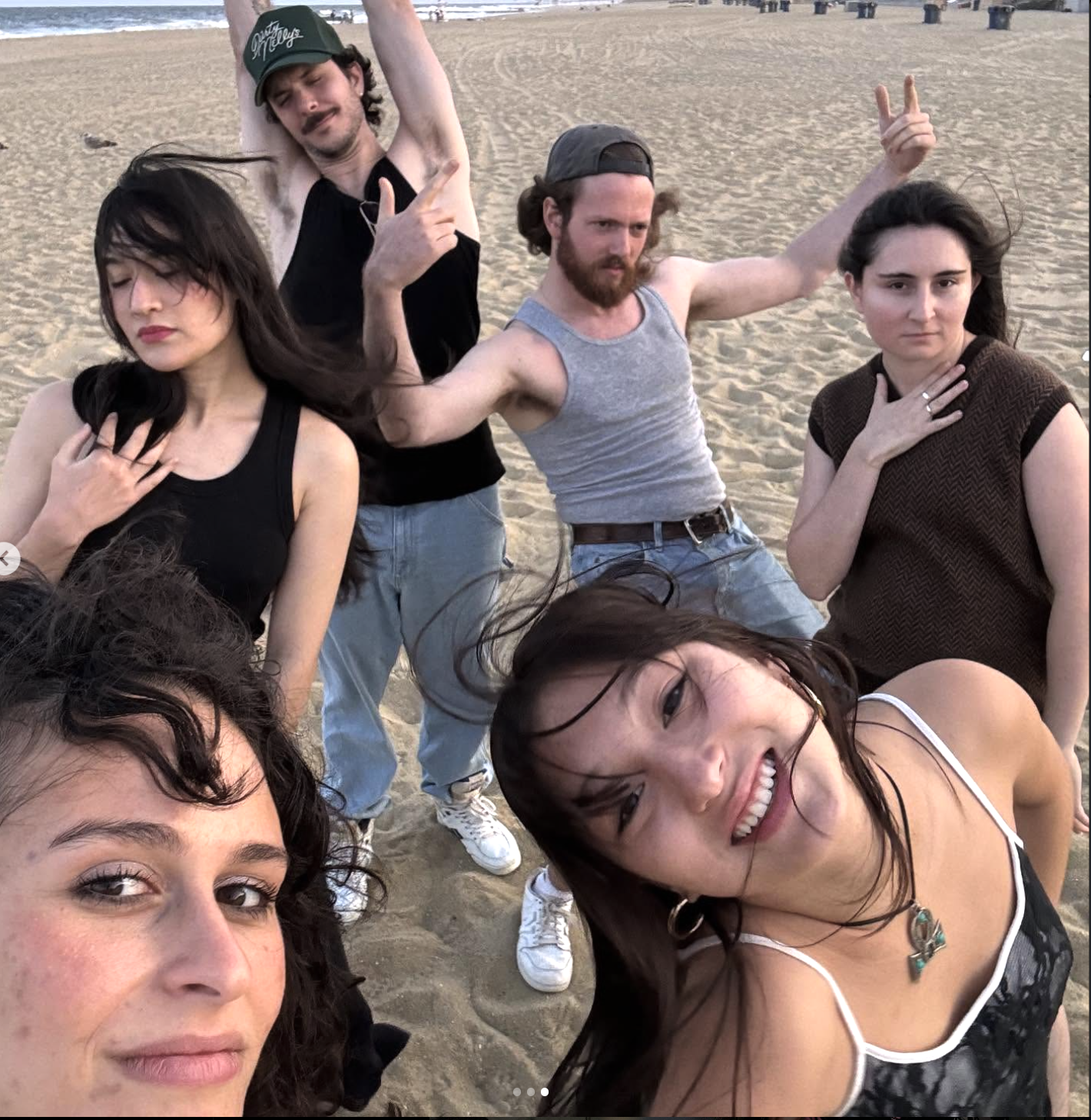
….which as its title indicates is technically not an EP at all but rather the second half of the band’s debut LP, following on from “Side One” a.k.a. I’m so charming, I forgot who I was (I) [bandcamp] released back in April and we love how they care about the larger framing cuz metanarratives still matter in today’s age of the algorithm and the endless malleability of streaming (arguably even more than before) so with no further ado we turn to the interview but first a brief introduction lifted from the band’s IG account with Pag singing the praises of her bandmates and of being creatively in sync:
“Creating music with my five ingenious, silly, anxious, creative, beautiful, funny, caring, sensitive, brilliant, insane, talented bandmates is one of the greatest gifts in my life. You create a world together. It is different and life-affirming every single time. It takes commitment and forgiveness and being vulnerable and being present. It is a calling to reach out into the universe holding hands, and in sync, and sometimes even perfectly in contradiction (“in harmony”) with five other people and feel the universe shepherding you back. This is no small feat and I’m grateful every single day.“
all music by pagona kytzidis, francesca pastore, jonathan ashley, claire lin jenkins, and andrew jordan; lyrics by pagona kytzidis; album art by natalie tischler; released September 26, 2025 on vengeful_baby
Marisa Whitaker: This is your full-length debut, and I love that you released it in two parts. Tell me about the early thoughts and intention behind it—the vision and why you split it into two.
Pagona Kytzidis: A lot of this music goes back almost ten years. I’ve been writing songs my whole life, and as a perfectionist, I don’t let go of them easily. It took until 2023 to find the right people to bring them to life. That’s how this record came together. At the end of 2021, after graduating from college, I had the idea for this record and how the story could fit together. I wanted a new band with a distinct sonic and lyrical vision born from a mix of gender crisis, coming-of-age crisis, and the pandemic.
The world was shifting—personally and broadly. I had material about coming to terms with a world that presents itself one way but isn’t that way. Much of it stemmed from my identity and reality as a survivor—reckoning with assault and gendered violence—and trying to reclaim personhood. I wanted to tell that story: how to come out of that, how to reclaim subjectivity, how to speak truths that are sometimes deeply unpleasant in a world that may not care to understand you.


The record follows that journey chronologically—from the lowest point to rebuilding. We really started working in January 2023 after our debut EP came out. The only member from that EP still with me is Fran, our guitarist and producer. By early 2023, we had a solid lineup, which allowed us to go deep into this project and its sound—something I’d always wanted. I’ve been told before that my music “doesn’t make sense,” so I wanted bandmates who’d not only say yes to my wild ideas but push them even further.
This record lives in extremes—of feeling, honesty, and a dark sense of humor. It’s where I’m comfortable living. The story itself was mostly built when we began in 2023, except for the first song, which ended up being the last one written. The songs are arranged with purpose, forming a distinct story: an opening of consciousness, breakdown, and rebuilding. The second half is about piecing myself back together—finding who I am—which ties into the title I’m so charming, I forgot who I was. That feeling of performing a version of yourself so intensely that you lose track of the real one—that’s where it came from.
“Tony Soprano”
MW: The first one, “Tony Soprano,” I love that title. People who don’t like Tony Soprano are more messed up than he is. I’m obsessed with him. It’s such a captivating start—extreme and ambitious in the best way, telling a powerful story. At times, I felt like I was in a getaway car with Tony Soprano, driving down the highway in Jersey. Were you trying to be Tony, sitting next to him, spitting at him, uplifting him—how does he fit into the story?
PK: This song captures the strongest sense of frenetic, manic energy on the record. It reflects where I was then. It stems from a particular time in college, during the Brett Kavanaugh hearings. The campus was divided, and everyone was losing it, myself included. It actually prompted me, for the first time, to seek therapy. I remember sitting across from a student therapist—they’d run out of professionals because so many people needed help.
I was barely sleeping, working constantly, losing friends because I couldn’t maintain patience for anyone who wasn’t going through the same thing. The therapist turned to me and said, “You sound like a great white shark. If you stop swimming, you’ll die.” That’s the same metaphor Tony Soprano gets from Dr. Melfi in The Sopranos. I started laughing and told her, “You probably shouldn’t use that one again.” That stuck with me, and I saved it to use later.
Years passed, and when I started writing this song, I wanted a manic rock track with that energy. It became a song about friendship—about my friends who were going through similar things and how we moved through the world together. The song’s about being “bitch sharks”—moving through chaos together with honesty and intensity. No one calls you crazy if you’re all crazy together. That energy fueled it.
I came into rehearsal with the words written but no music. I turned to Fran and said, “Write me a mean riff.” She came back with what became the sound of “Tony.” The ending, that cascading line, captures this performance of finding power and subjectivity while the world reacts with fascination or disgust. That’s Tony—the mania, the performance. But the end strips that away, revealing pain and loss—the kind you face only with people who love you. It’s about what’s underneath the performance. The Tony metaphor felt funny, cheeky, culturally relevant—and it came from that therapy moment where I got compared to Tony Soprano.
“knowing”
MW: I was looking for the lyrics and realized it’s only twenty seconds long! I love an interlude; every album should have one if it fits. What was the purpose of having that short instrumental bit?
PK: Honestly, because our songs are long. If “knowing” were part of another track, most songs on this side would be over five minutes, and we thought we’d be punished. We split the album into two because it’s our debut, and we didn’t want it to get lost. We’re completely DIY — we do everything ourselves—so we wanted to maximize the release cycle. In hindsight, releasing two parts in one year burned me out, but it made sense strategically. So “knowing,” and the Baroque intro to “goodbye. goodbye” on the first half, were separated for pacing. We wanted to keep songs relatively short where we could, an idea we’ve since abandoned. You’ve heard some of our new stuff; the songs are getting longer again. Attention spans are short, but our songs lean traditionally five or six minutes. It’s just the reality of the streaming world.
“pink/green”
MW: It’s such a left turn from “Tony Soprano.” It’s sweet and dainty—pink and green are complementary but opposite. The horns are gorgeous, sensual, and that instrumental climax is moving. Tell me about it—the lyrics, the story, the meaning.
PK: We joke that partygirl never lets them know the next move. Going from “Tony” to a jazzy ballad made sense to us. This song’s a remnant from my college band. I wanted to keep it because it was beautiful. It’s the closest I’ve written to a love song. It’s based on a moment at a party freshman year—I was drunk, bartending, mixing terrible cranberry vodkas, looking out the window at the green outside. I had this rush of romantic feeling, this sense of loving the world around me.
The lyrics came from that, but also from my anxieties about being intense and independent—wanting love but fearing abandonment. The lines about remembering my possibilities or “please don’t just leave me here” came from that tension. It’s about finding yourself, learning to love without losing autonomy. I wasn’t coherent about it then—I was nineteen, jotting things down drunk—but it came from that place. We shortened the song a lot when arranging it, cutting verses and choruses to let it build slowly into David’s sax solo. It crescendos into this huge moment before dropping to a whisper of fear and vulnerability.
“option”
MW: This one feels more straightforward lyrically but is still powerful. I love the long instrumental at the end and that drum-heavy intro. Tell me about “option”—how it ties into the story as a whole.
PK: Narratively, my character—or me—is numb by this point. The song came from realizing I wasn’t going to be a romantic option for certain people in my life. The original line was “Love is not an option,” but I changed it to “I am not an option.” It felt truer, reclaiming myself instead of framing it around love. Musically, it’s our proggiest song—lots of interlocking parts, shifting rhythms, and harmonies.
It mirrors how people communicate: you say one thing, I say another, meanings overlap and conflict. I’ve always been straightforward, but you still end up in situations with breakdowns in understanding. This song came from those moments—trying to figure out what people mean to each other, how much you actually know someone. It’s like puzzle pieces without the full puzzle. It’s a sweet thing to try to uncover.
The way the song ends—that long instrumental part and guitar solo—that dance feels human and interesting. I’m not afraid of trying to know people or be known, but losing people in that process is almost inevitable. That’s what it means to grow up. The song doesn’t end with a bang—everyone drops out until there’s just this lone violin part standing there. What does it mean to be the last person left in the conversation? I don’t know, but that’s what this one explores.
“new year’s resolution”
MW: I love this one too. It feels more like a ballad, full of longing. Not sad exactly, but tender, emotional. In a way, “new year’s resolution” feels like a beginning—starting over, making goals, reflecting. It’s the second-to-last song on the album, but it feels like a birth.
PK: Yeah. All that’s true. This one’s me at my most vulnerable, which is saying something. Vulnerability doesn’t come naturally to me—I’m a performer. I find comfort in the vulnerability of performance, more than in showing how I actually feel. I first wrote this song on New Year’s Day 2016. I was 16. I’m 26 now, almost 27, that’s how long some of these songs developed. The first version came from those chaotic, dramatic New Year’s nights with my friends. You go in with all these promises of newness and end up turning them into the same problems—just neatly laid out in one night. That happened in 2016, again in 2019 when I revised the lyrics, and then again in 2023, which became the final version.
That New Year’s, after a few years off, my high school friends and I met at my friend’s mom’s horse farm in New Jersey. We had this wild, beautiful party, and then I woke up to bad personal news—being dumped over the phone, basically. But it’s not about one moment. It’s about patterns over time, going in full of hope, writing your fears down to burn them away and waking up again with that weight of betrayal on your chest. It’s like, “You played yourself again.” But that time, I knew it was the last time. The song takes all those ideas—the cycle of renewal and disappointment—and turns them into something almost triumphant. You wake up from this night of hedonism with clarity, despite the hangover, the snow, the mess.
I’ve literally walked home in heels through ice—terrible decision—but it’s part of the story. It’s about renewal and the honesty that comes with it: trying again after betrayals, whether they’re violent or everyday ones. Knowing who you are, knowing who you shouldn’t be. The ending, with that partygirl-style build and string arrangement—Claire, our violinist, layered four or five violins to create this droning, harmonic texture. It’s one of the most vulnerable songs I’ve ever written. We don’t really play it live, maybe because it’s more of a ballad. But it’s deeply personal…[where] vulnerability really blurs with reality.
The “Partygirl” character has a mind of her own. I’ve talked a lot with my friends who work in theater about how to stay safe performing such dark, truthful material—how to step into a character, then step out afterward, so you don’t lose yourself. That’s helped me maintain my mental health and my relationships. That’s part of the partygirl mantra—keeping those boundaries. “Tony” might be harder material, but it’s easier to perform than this one. This one’s like looking in the mirror and choosing which path to take. That’s the point of it.
“birdspotting”
MW: You’ve got the full band; it’s so rock and roll. Probably the most rock track on this side of the project. It seems like this one might be about a single person, but it also feels broader—like you’re questioning everything. And the closing line, “I’ll do anything,” feels like the thesis of your entire project. You did everything here: musically, emotionally, conceptually.
PK: It’s my favorite because it is the thesis of the whole record. It comes after “new year’s resolution,” like, “Okay, I know who I am, how I’ll be treated, what I want.” I’m still mad, still angry. This one, like many of my songs, came together from fragments. The first half, before the chaotic ending, came from that period of COVID isolation we all experienced. I was sitting in my car at a COVID test site in Pennsylvania—on top of a hill at sunset, surrounded by trees. It was beautiful and apocalyptic at the same time. That moment set the tone for a series of reflections.
The song was inspired by conversations with a close college friend. We took classes together every semester and bonded over bird-watching during COVID. I got really into birds. I’m named after one; Pagona means “peacock” in Greek. So it felt natural. We’d go to Central Park to look for this famous snowy owl and talk about life, the world, and the chaos around us. That friend once wrote a paper about shopping malls as public spaces in rural New England, where literal town meetings happened. That imagery stuck with me—all these contradictions of modern life—and shaped the song. It’s about realizing the world isn’t what people said it was. Feeling betrayed by false versions of reality.
The first half reflects that post-modern confusion, doublespeak, trying to make sense of a world that doesn’t add up. Then, in true partygirl fashion, the second half breaks everything open. The call-and-response is fun live, but then it crashes into this ending: “I’m begging, I’ll do anything.” That line came from a place of desperation—trying to understand the world and myself, but not having the tools. You finally hear the album title there: I’m so charming I forgot who I was. It’s about performance, confusion, power, and identity. It’s angry—about being seen as something to be used or lied to, whether by a person or by society. The rage comes from that, the question of “What’s the shelf life of a pretty little thing?” How long until it breaks? That’s how the album ends—not with answers, but with catharsis. You know more than before; maybe not everything, but enough to keep going.
MW: What do you want people to take away from the project as a whole?
PK: I’m most moved when people tell me they connect with it. You can interpret it however you want. I wrote from my experience in a particular moment. But feelings of displacement, conflict, uncertainty—that’s universal. A lot of this record is about not feeling alone. I’ve been lucky to have friends who’ve never made me feel that way. They saw every draft, every stage. My bandmates literally built this with me. It wouldn’t exist without them.

And beyond that, do your weird, crazy art. I hate how art is flattened by algorithms and nostalgia. Art should be communal and spiritual. It should make people feel. That’s what matters. If this record inspires anyone to make something raw and strange, that’s the goal. I don’t care about genre. These songs are prog, pop, whatever—they’re honest. I want people to make things that move others. For me, this band made my life make sense. It gave me purpose. Every show, every moment on stage, it’s alive, different each time. That’s what I got from it, and I hope other people find that—a reason to feel alive, to connect, to believe in art as something that moves people.